


How to Issue a By-Law Contravention Notice
Published:
Modified:
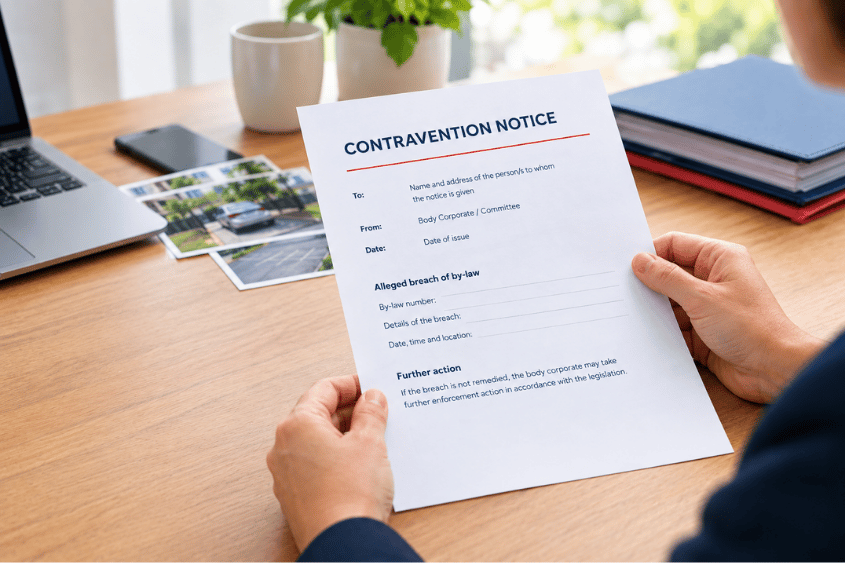
A contravention notice is the formal step a body corporate takes before it can pursue further enforcement action against an owner or occupier over an alleged by-law breach. Under the Body Corporate and Community Management Act 1997 (Qld), it’s a legal prerequisite, not a warning letter, and the requirements around what it must contain and who it must be given to are specific.
Committees often focus on the substance of a complaint – the noise, the parking, the pet, and treat the notice itself as a formality. But if it isn’t put together correctly, it can undermine an otherwise legitimate case before it even gets to conciliation or adjudication.
This guide sets out what a valid contravention notice needs to include, common pitfalls to watch for, and a practical checklist to run through before a notice goes out.
What Is a Contravention Notice?
A contravention notice is the formal written notice a body corporate must give an owner or occupier before it can take further steps to enforce a by-law, such as applying for conciliation or seeking an order from an adjudicator or the Magistrates Court.
It needs to do two things clearly: identify the specific by-law the body corporate believes has been breached and explain how the person is alleged to have breached it.
A notice that is vague, for example is only references “a parking issue” or “the by-laws” generally isn’t enough. The recipient needs to be able to understand exactly which by-law they’re alleged to have breached and what they’re supposed to have done, so they have a genuine opportunity to respond or correct the issue before further action is taken.
Citing the Wrong By-Law
Schemes can have several by-laws that appear to cover similar conduct. For example, one by-law regulating parking on common property, and a separate one dealing with storage of items on a lot. The wording and scope of these by-laws can be quite specific, even when the underlying behaviour may outwardly look similar.
If a notice cites one by-law but the conduct falls under a different one, the notice may not properly address the alleged breach. This isn’t just a technicality. Adjudicators have found that citing the wrong by-law means the required enforcement step hasn’t been completed, which can mean starting the process again from scratch.
What to do: Read the exact wording of the by-law you intend to cite and confirm it applies to both the conduct and the location involved, before drafting the notice.
Not Describing the Conduct Clearly Enough
It’s not enough to simply quote the by-law. The notice also needs to explain what the person is alleged to have done, where, and why that amounts to a breach of the by-law in question.
There’s a real difference between “you have breached the parking by-law” and explaining specifically what was observed, where it occurred, and how it contravenes the rule being cited.
The first gives the recipient nothing to respond to. The second gives them (and, if it goes further, an adjudicator) a clear picture of the allegation.
What to do: Include specific facts – what happened, when, and where, rather than relying on the by-law wording to speak for itself.
Sending the Notice to the Wrong Person
A contravention notice must be given to the person believed to have breached the by-law. If the alleged breach was committed by an occupier who isn’t the owner, the notice should be directed to that occupier, with a copy also given to the owner.
A body corporate also shouldn’t assume an owner is automatically responsible for the actions of a tenant, visitor or other occupier.
If the breach is conducted by a visitor to the scheme, they are bound by the same by-laws, but enforcement action is generally taken against the owner or occupier, not the visitor directly.
What to do: Confirm exactly who is alleged to have breached the by-law before the notice is drafted and address it to that person specifically.
Is Evidence Required?
The body corporate must be specific about the allegation, but there is no requirement to provide ‘evidence’.
To issue a by-law contravention notice, the committee must simply have a reasonable belief that the by-law offence has actually occurred. It is common for by-law contravention notices to be issued based on complaints by other residents.
For example if a by-law contravention notice was issued for a loud party, the committee would not be required to demonstrate, with evidence, that the noise reached a certain decibel level. It would be good enough to describe “the by-law was breached when the residents had a party on Saturday night that went late into the night and was very loud, disturbing other residents and generating complaints”
What to do: Keep a running record as issues arise – dates, times, locations, photos, and witness accounts, rather than trying to reconstruct this after a dispute has already started.
A Checklist Before You Issue a Notice
- Have you read the exact wording of the by-law, not just a general summary of it?
- Does that by-law apply to this conduct and this location?
- Does the notice explain what happened, not just which rule applies?
- Is the notice addressed to a specific, identifiable owner or occupier?
If any of these can’t be answered with confidence, it’s worth pausing and checking before the notice is sent.
Related content
Subscribe To Our Newsletter
More To Explore

Who can approve significant body corporate spending?
Who can approve significant body corporate spending? Learn how the committee spending limit works, when owners must vote and when two quotes are needed.

What Does ‘Acting Reasonably’ Mean for a Body Corporate Committee?
“Act reasonably” is a phrase that appears throughout body corporate law. It’s a legal standard that applies to almost every decision a committee makes – enforcing by-laws, approving or refusing applications, spending scheme funds, engaging contractors, and resolving disputes between owners.

